Friday, 5 October 2012

Secret of OPEC basket of crudes to Friday

 
Friday said OPEC and said that the standard price of its basket of crudes may record low of 107.08 dollars on the previous day to 106.99 dollars a barrel on Thursday.
It is known that the OPEC basket of 12 crude is a mix

 
deserts Algerian ore Angolan and Iranian crude and heavy Basra Light Iraqi export Kuwaiti Sidr Libyan and Bonny Light Nigerian maritime country and Arab Light Saudi Murban UAE and Mary Venezuelan and Orient from Ecuador.

New York Times: Egypt still attractive for investments oil companies


The newspaper "New York Times" U.S. report Thursday that despite the financial difficulties faced by Egypt in paying the bill oil and debt higher for international oil companies operating out van this companies are able to withstand high levels of debt are still attracted to investment in the oil sector Egyptian gas is likely to detect.
She said NH For example, British Petroleum Company decided last September to invest $ 11 billion in a gas project in Egypt, which is expected to produce, when completed, 40% of the total natural gas production in Egypt.
The company agreed Apache American Petroleum last February to spend billion dollars in the development of Egyptian hydrocarbons during the next two years.
The newspaper pointed out that due to growing domestic consumption in Egypt accelerated the trend in Egypt ended the use of its share of production locally instead of earning more revenue necessary export as the country moved from export to import over the past decade.

She explained that under the financial and economic conditions faced by new Egyptian government estimates indicate the government by between 6 to 7 billion dollars for the benefit of foreign companies for oil and natural gas produced by these companies and handed over to the company Egypt General Petroleum owned by the state.
The newspaper "New York Times" on its website, citing oil executives that the Ministry of Petroleum in negotiations to reach a new pay deals with those companies that are among the largest investors in the country.
In this regard, the company noted Dana English Petroleum which has a branch in Masraly it received 78% of this late Madionat by last April but still looking "different forms to schedule the remaining amount with Egyptian General Petroleum Corporation.

The newspaper pointed out that Dana like the other companies involved in oil exploration in Egypt, including the BP British and Italy's Eni and Spain's Repsol are with Egypt General Petroleum joint projects to explore oil and natural gas system of partnership between the state and the company.

She said most expenses, government recede in providing support to keep natural gas prices without market rates as it Egypt by cheaper fuel prices in the Middle East and therefore it is not surprising that the value of an invoice Egypt for support in order to maintain fuel prices have jumped to nearly 16 billion a year.

Tuesday, 25 September 2012

US Dollar Gains as Global Economic Fears Return to Focus

 US dollar is gaining ground as Forex traders look for safe haven amidst concerns about 

what’s next. Lackluster data from China and from the United States itself has
about what could be coming for the global economy. The result is that Forex traders are looking for a little more safety right now, and the greenback is benefitting.
Fears about the rate of global economic growth are once again coming to the fore. Concerns that China won’t be there to pull the world out of its economic doldrums are mounting. On top of that, even though the United States economy has been showing some small improvements, things are far from a growth rate that many prefer to see.
It’s not helping, either, that eurozone problems continue to dominate. Once again, there is disagreement between German Chancellor Angela Merkel and French President Francois Hollande about what should be done to ensure that the sovereign debt crisis doesn’t repeat itself. With a disagreement over when to implement the banking union for the eurozone, and with recession looming for the 17-nation currency region, it is little


 surprise that, once again, Forex traders are turning to the stability of the dollar.
At 12:26 GMT EUR/USD is down to 1.2912 from the open at 1.2978. GBP/USD is down to 1.6194 from the open at 1.6238. USD/JPY is down to 78.0085 from the open at 78.1600.
If you have any questions, comments or opinions regarding the US Dollar, feel free to post them using the commentary form below.

Franc, SNB & Euro-Peg: Can Swiss Central Bank Maintain Ceiling?

 The Swiss National Bank took an unprecedented step to weaken the franc as
 cap of 1.20 francs per euro back in September 6, 2011. The move followed


 unsuccessful attempts to devaluate the currency. The announcement immediately met criticism from skeptics who did not believe that such a ceiling is sustainable. Was the intervention successful and, what is even more important, can the central bank to maintain the euro-peg in the future?
The franc slumped after the introduction of the peg, yet it immediately started to rise. The appreciation was very slow, but steady. By the April, the Swissie was trading near the ceiling. In fact, the currency broke through the 1.20 level on April 5. Thomas Jordan, the Chairman of the Governing Board of the Swiss National Bank, explained the event:
Despite SNB offers placed in the trading systems, a few isolated transactions occurred below CHF 1.20 per euro. However, at no time did the best available euro exchange


market fall below the minimum exchange rate of CHF 1.20. Thus, for a short time
what is known as a segmented market could be observed, in which transactions below the best price were concluded. This situation was remedied within very few seconds, however, by means of arbitrage. 
Jordan explained that the central bank cannot control unregulated currency markets even

 though the SNB can trade and influence them through its counterparties, which consist of more than 100 banks. The Swiss central bank remained committed to maintain the cap and, indeed, the franc was not able to breach the ceiling since then.

US Dollar Classic Technical Report 09.25.2012


US DOLLAR INDEX: Prices re-testing the previously broken bottom of a rising 


channel set from the September 14 low (now at 9831). A break higher initially exposes the 38.2%Fibonacci retracement at 9857. Near-term support lines up at 9783, the 23.6% Fibonacci expansion, with a break below that targeting the 38.2% expansion at 9738.
Concerns about global economic growth are mounting, demand for safety rises and Forex market participants are still questioning the sustainability of the peg. Can the SNB keep the 

ceiling intact? As it usually happens, opinions are divided on this matter.
rising inflation, the ability of the Swiss economy to cope with a strong currency and a potential for the intervention to reach 100 percent of Switzerland’s gross domestic product. The deflationary pressure was one of the main reasons for the central bank to introduce the ceiling and as that danger of deflation subsides,

so the incentive for the bank to keep the peg. As for the nation’s economy, GDP was rising steadily this year, showing that Switzerland is indeed on track to robust economic growth. That gives support to the opinion that the danger of a strong currency was overestimated. As for the matter of capital controls, most experts think that such measures never proved effective and, besides, the international community is not likely to be pleased with such blatant currency manipulation. There are already many voices that compare Switzerland to China.

Sunday, 23 September 2012

Stocks Finish Mixed on Late Weakness


Equities were in positive territory for most of the session with investor sentiment lifte

for clarity on a rescue program for Spain, strong quarterly results from homebuilder KB Home (KBH) and the global availability of Apple's (AAPL) iPhone 5, but selling pressure arrived in the final hour.
The Dow fell more than 17 points, or 0.13%, to close at 13,580. The blue-chip index, which was up nearly 50 points at its high for the day, snapped a three-session winning streak and was down 0.10% for the week.
Find out what stocks Link and Cramer are trading before they trade them
Decliners outpaced advancers within the Dow, 17 to 13. The biggest losers were Alcoa (AA), Cisco (CSCO) and Coca-Cola (KO).
Blue-chip winners included Exxon (XOM), General Electric (GE), and McDonald's (MCD), which rose 0.60% after announcing a 15% dividend hike.
The S&P 500 was down incrementally, slipping 0.01%, to settle at 1460.

week down 0.41%. The Nasdaq was the lone winner, adding 4 points,
 or 0.13%, to close at 3180. The tech-heavy index lost 0.12% on the week.
The strongest sectors in the broad market were health care and energy. Transportation, basic materials and consumer non-cyclicals were in the red. Volume totaled 4.75 billion on the New York Stock Exchange and 2.53 billion on the Nasdaq.

There was some optimism in early trading following a report that European Union officials are working to pave the way for a new rescue program for Spain. The Financial Times said an economic reform package for Spain is expected to be revealed next week.
The paper said the program will concentrate on structural reforms for Spain's economy instead of more taxes and spending cuts.
"With the decision-making process of the Euro area distilled down to a very small number of people, such stories are just speculative," noted Paul Donovan, global economist at UBS. "However, Spanish conditions relating to structural reform not fiscal targets would be helpful, as Spain stands a good chance of missing its fiscal targets."

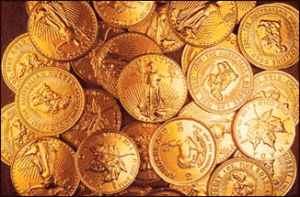
Gold Price Today


Friday’s PM gold fix of $1576 (£1007, 1296 euros) per Troy ounce was the 10th week that Friday’s gold fix prices have alternated between up and down since week ending 11th May 2012.
As we mentioned a few weeks ago, the gold price is stuck in a range of $1555 – $1635 and that range is contracting as it fails to break through $1600 in the near term. It is one of the tightest weekly trading ranges that the gold price has seen since the beginning of the bull run.
“Daily momentum is flat” Tim Riddell, ANZ Bank head of global markets research, notes.
For pound sterling and US dollar investors the gold price is the same that it was two months ago.


 Yet despite the above we’re convinced the gold price can run further…
Two main drivers of demand for the gold price remain. Inflation and the US Dollar trade deficit.
In the UK we’ve seen a reversion to Quantitative Easing, with the latest £50m spending adding to the pot of debt that is continuing to mount. And whilst unemployment has


Friday, 21 September 2012

Gold Prices


Gold prices may seem a little mysterious at first, but in fact they are no different than those of things you buy every day. Like everything else, gold originates with producers (mines) then travels down a distribution chain to the end consumer.
The top of the gold distribution chain is the over the counter (OTC) market, where prices are driven by supply and demand. Because gold is a commodity its price is independent of the source. On the OTC market principal buyers ‘shop’ producers for the best offered price, negotiate a contract with a producer, and then execute the physical exchange. From there gold passes down through various levels of 

wholesalers to the retail market.
Gold prices to the end consumer can vary considerably depending on how many hands it passes through and the markups applied along the way. Clearly the only meaningful and unambiguous benchmark for gold prices must come from the top of the distribution chain.

Wednesday, 1 August 2012

Health insurance companies owe nearly $ 74 million in rebates to residents of California


Will be nearly 2 million residents of California received $ 73.9 million in cuts from health insurance companies as part of the Code of Federal health care, according to state officials.

Insurance companies to notify regulators in June, the government of how much they owed to customers in the premium rebates or credits because they did not spend at least 80% or more from 2011 premiums on medical care. And the minimum is 85% for employers with more than 51 workers.

Figures released Tuesday to mark the end result of California, insurance companies must be issued refunds by Wednesday. Has received many employers and consumers are already messages informing them of the amount of their opponent.

Average discount is $ 65 per family, according to the State Department of Insurance.

"The law requires care at reasonable prices that have spent more than dollars to our health insurance premiums and health care, rather than on administrative costs and profits," said the Commissioner of the California Insurance Dave Jones.

Owed by Anthem Blue Cross, the largest country in the profitability of insurance companies and unit of a needle, approximately $ 40 million in rebates and Blue Shield in California and had to return about $ 11 million to customers.

Due to non-profit Kaiser Permanente, the largest insurer in the state $ 0.277000 in discounts to holders.

United Group, Aetna Inc. and CIGNA Corporation owed all California employers about $ 3.4 million.

At the national level, and federal officials said health insurance companies owed $ 1.1 billion in cuts to up to 12.8 million Americans. Discount the average national level of $ 151 per family, according to the federal government.

For people who get health coverage through work, and verification of the discount or credit goes to the employer. By law, employers can be revenue-sharing with employees on the basis of how much they contribute to the annual installments or apply the savings in health care costs in the future.

And individuals and families who buy their own policy receive rebates directly. Consumer advocates praised the new restrictions on insurance companies costs and profits.

"The choice is a symbol of new controls on the industry to ensure patients get the best value per dollar premium for it," said Anthony Wright, executive director of Health Access California, a group defending the rights of the consumer.

In Picking Facebook Shares, Repeating the Mistakes of the Past


Since the collapse of the dotcom bubble in 2000, small investors were wary of the right of the stock market. Facebook was going to change everything, so the average investor returns.

Instead, Facebook was a massacre of individual investors, highlighting once again why the stock selection is a game loser. This was a huge uproar about Facebook as investors on the retail salivated at the chance to buy what they hoped to be the next apple. Even now, after initially trading above $ 40 a share, and shares now down nearly 43 percent of the subscription price.

For example, Facebook is one more confirmation of the studies showed that, on average, and individual investors consistently lose when buying and trading of individual stocks. They are better off investing in index funds is negative.

Professors Brad Barber and M. Terrance Odean recently issued a paper survey evidence. Studies of individual investor trading and found that "many investors earn poor returns even before the costs." Those investors trading bad and tend to lose more money than they would using a simple buy and hold strategy in the boxes that correspond with negative indicators such as Standard & Poor's 500-stock index.

How big is the loss? The same authors in another study of 65,000 investors found that the 20 percent who traded most actively earned 7 percentage points a year less than the buy-and-hold investors, the 20 percent who traded least actively. For the individual investor, that can add up to hundreds of thousands of dollars over a lifetime.

This is not surprising. Even mutual fund managers have trouble beating the market. Last year, according to S.& P. Indices, 84 percent of actively managed funds did not beat the Standard & Poor’s index representing that fund’s sector. Going back over five years, 61 percent of funds underperformed. Even so, most mutual funds beat individual investors who try to do it themselves.

If the professionals have such problems, individual investors don’t have a chance. They are not as knowledgeable and not as disciplined. Study after study has found that individual investors have a disposition effect — that is, they tend to sell winners too soon and hold on to the losers by refusing to recognize their failure.

Individual investors are also heavily influenced by their mind-set and their environment.

For one, they are strongly influenced by media reports and buy stocks that are promoted. And, yes, there are studies of Jim Cramer’s show, “Mad Money,” and this effect. One recent study found that the higher the viewership of the show, the bigger the market reaction to stock recommendations. The authors also found that Mr. Cramer’s buy recommendations had more influence than sell recommendations, reflecting people’s desire to bet on winners. But didn’t we know that already from the tech bubble? More than a decade ago, stocks of companies with little or no profits were wildly hyped. It all ended badly, with retail investors losing the most.

In full disclosure, I’m still a little bitter about that. In 1999, I bought Ask Jeeves stock at about $120 a share, eventually selling at below a dollar before shares went up 28-fold and the company was sold to IAC/InterActiveCorp. I’m unfortunately a great example of how retail investors can time things perfectly wrong as they become part of the herd. The Facebook affair was but a sad repeat.

These inherent flaws put us off on the wrong foot when we pick and trade stocks. We don’t diversify enough, don’t do enough research and tend to sell on emotion rather than logic.

If this weren’t hindrance enough for even the most educated individual investor, the Facebook debacle shows that the market is rapidly changing in ways to make it even harder for individual investors to profit.

In the case of Facebook, the profits from investing were largely taken from individual investors before the I.P.O., by trades in the private market where most individual investors could not trade. Goldman Sachs, for example, led a private investment round at a $50 billion valuation only a year ago, selling a third of the stock in the offering at about double the price. By the time Facebook came to market, there was little left for average investors.

The losses in Facebook show that Wall Street doesn’t seem to care much about the individual investor. Companies are increasingly going public with structures that disenfranchise stockholders, or they are looking to cash out and go private just before things get good. Investment banks furiously peddled Chinese issuers to a public that didn’t seem to care much about the companies’ problems.

Instead, the markets have become the domain of hedge funds, where high-frequency trading peels off short-term profits. In the longer term, the severe underperformance of mutual fund managers last year was attributed by Horizon Advisors to the volatility in the markets and the increasing correlation of stocks. As stocks move together, or become correlated, picking winners that offer returns higher than the market average becomes more difficult.

Beyond all of these barriers, individual investors are also faced with a stock market that has remained stagnant for the last decade.

So what can be done?

One thing to consider is whether to further educate individual investors on the problems of investing on their own. The studies show that in general, investors are better off in passively managed index funds. But even here, investors tend to defeat themselves. At least one study has found that investors who engage in passive exchange-traded funds eat away the gains in performance by using this as an excuse to trade more. The problem again occurs when investors try to trade on their own.

In light of this, more disclosure and education would be nice. Perhaps Mr. Cramer’s show could begin each segment with a note spelling out how much investors lose when they trade on their own. The warning could be given to all investors when they sign up for brokerage accounts. And because not everyone will heed this disclosure, the government might take steps to limit the ability of people to trade in their retirement accounts, where the bulk of Americans hold their invested wealth.

But the bottom line is that more needs to be done to educate and help individual investors. It should become common knowledge that investing in an individual stock and trading may be fun, but it may also be dangerous to their wealth. Perhaps the warnings could start with a confessed Facebook I.P.O. investor.

Steven M. Davidoff, writing as The Deal Professor, is a commentator for DealBook on the world of mergers and acquisitions.

Will Apple Join the Dow, Finally?


Who is more to blame: the keepers of the Dow Jones industrial average, who refuse to add Apple (AAPL), the world’s most valuable company, to the index because its stock price is too high? Or Apple, creation of late stubbornista Steve Jobs, for refusing to split its successfulstock to conform to the Dow’s peculiarities?Hopefully, it soon won’t matter. And I won’t have to expend another man-hour complaining about it.According to a research report from Sanford C. Bernstein (AB), Apple is finally considering splitting its $600-plus stock in a way that could right-size it for entry into the venerable (ancient) blue chip index. Apple IPO’d in December 1980, finishing its first day of trading with a then-jumbo $1.7 billion valuation. Today it’s worth $568 billion and represents nearly 5 percent of the Standard & Poor’s 500-stock index—but fully zero percent of the 30-member Dow, the world’s most cited stock market average. For comparison’s sake, Apple is now worth roughly 16 Hewlett-Packards; HP (HPQ) has been a member of the Dow since 1997. Microsoft (MSFT) andIntel (INTC) were added two years later; combined, they are still worth less than Apple. The Dow people are nothing if not prescient.Apple reached Chevy-in-every-garage status during the past 10 years, as its iPods, iPhones, and iPads disrupted music, mobile, retail, and the earth’s gravitational pull. In 2009 the Dow had every justification to add Apple instead of Cisco Systems (CSCO). But it went with the latter. Apple—and Google (GOOG), for that matter—have been denied inclusion because the shares would overwhelm the Dow, which weights components according to the otherwise incomplete data point of stock price. In other words, 3M (MMM) currently affects the Dow more than ExxonMobil (XOM) simply because its stock trades $4 higher—not because it’s more relevant to investors than the nation’s most influential and highly valued energy company.The Dow’s error of omitting Apple looks worse by the day: Its stock has since shot up from $139 to $610. At that price, Apple would throw around three times the influence of IBM (IBM), which now has the largest weight in the Dow.Apple’s decision in March to pay its first dividend in 17 years makes it more likely the stock could be added to the index after a split, according to Tuesday’s Bernstein report. “We see the timing as ripe,” wrote analyst Toni Sacconaghi, who noted that Apple is the only dividend-paying company with a more than $215 billion market cap that has yet to be inducted into Club Dow.Members of the index must have an “excellent” reputation, show sustained growth, and “be of interest to a large number of investors,” according to the website of S&P Dow Jones Indices, which oversees the Dow. Assuming Cupertino feels it measures up to those standards, Apple could get its opening later this year when member Kraft Foods (KFT) splits itself in two.Does it really matter? Less than $30 billion in products such as exchange-traded funds—a trickle in institutional investing—track the Dow, while nearly $6 trillionbenchmark against the S&P 500.My beef with the Dow-Apple impasse is more about the opportunity cost in investor morale. A more timely inclusion of Apple into the Dow might well have brought the index to all-time highs by now. How great would it have been to hear the evening news lead with that much-needed milestone? The world’s most admired and highly valued company managed to pull off the bulk of its success precisely as the market and economy went to hell: The iPhone launched in June 2007, as word first emerged that Bear Stearns was in trouble. Apple, whose stock has since gained 400 percent, was perhaps the best, proudest thing corporate America had going for it. Great Recession be damned. Consumers wanted everything this company made, and they were willing to camp out for it.Apple represented so much of the economic reality that the Dow Jones industrial average aspires to track. But the rules are the rules, and we were robbed. Better late …

HSBC allocates $ 700M for money laundering fines


HSBC headquarters in Hong Kong. And apologized for allowing the company to launder money through the arm in the United States. Photo by Bobby Yip / Reuters
HSBC and apologized for the "shame" the collapse of the systems that failed to stop the bank from money laundering to terrorists and drug barons as they set aside $ 700M (£ 445m) for Potential fines in the United States and 1.3bn dollars other ill-sell financial products in the United Kingdom.

The Bank insisted that those responsible for violations of the rule in the United States, Mexico has left work and had made up the bonuses back from staff who are allowed to pump billions of dollars through illegal financial system.

Given that the clawback was possible only since 2010, focusing attention on the former chief executive Michael Geoghegan and Sandy Flockhart, the former head of Mexican operations, who left this month for health reasons, and a candidate for the clawback. The other bonuses have been reduced.

Admitted to Stuart Gulliver, chief executive of HSBC, the fine in the end that the U.S. authorities may be "higher, perhaps much higher," after the report of the Senate in the United States and found that the arm it had allowed to launder money for terrorists and drug barons because of " widespread pollution of its "culture.

He said Gulliver, who took office last year after 30 years in the bank, the bank reform "the structure of the Union" in an attempt to avoid re-run of the problems in the United States. "I very much regret the failure of HSBC in the past and very much apologize to them," said Gulliver also reported a rise in bank profits to $ 12.7bn (£ 8bn), although the basic earnings fell by 3% to $ 10.6bn.

"What happened in Mexico and the United States is a shame, it's embarrassing, it's very painful for all of us in the company," said Gulliver.

HSBC also has had to allocate another $ 1.3bn for mis-selling payment protection insurance (PPI) for individuals and interest-rate swaps for small businesses. From this, $ 1bn is the producer price index - where banks all over the UK has now taken the provisions of £ 8.5bn - and $ 240m of interest-rate swaps. Led to the provisions of the sale of poor European business to the loss of $ 667m in the first half.

No longer run the bank and the process with a presence in 80 countries ", where the head of state is King," but it is an integrated work with the four heads of the global concentration of standards and controls through a beefed-up compliance. Spend of $ 400M last to comply.

Gulliver said, that reward is linked to a bank's reputation, "In light of this new strategy, HSBC and now runs and managed as a truly global, making it easier to identify, monitor and enforce standards."

Also been discovered in the bank fraud scandal Libor, but did not put any text on a fine or possible cases illegal. The Barclays Bank was fined £ 290m to manipulate Libor On Tuesday, Deutsche Bank will face questions about their exposure to regulatory investigations into the attempts to manipulate the key interest rates.

He said HSBC Gulliver can discipline people and claw back bonuses as a result of money laundering scandal in the United States, covering the period from 2004 to 2010. The president refused, Douglas Flint, to say how many employees who have left or bonuses may be recovered, other than to say that it was "more than a few." Flint and apologized as well. "HSBC has made mistakes in the past, and for them I am very sorry. Frankly, in certain areas and we have not lived up to the standards that I and my colleagues, and our regulators, customers and investors expect," he said.

"We can not undo the mistakes but I can assure you that is determined by Stuart Gulliver and I, and made it a priority to the most important, to promote the HSBC and promote our values."

The bank is also bleak for Europe, said while "European leaders will take the necessary measures to maintain the euro", and in the euro zone economy will contract this year, and in the United States will not be there, "subpar growth." He predicted that there will be "landing" in China. They pay dividends in the second quarter of $ 0.18. Shares closed 12p higher at 543.1p.

One week to get the big economic news


Recession of the summer the so-called, was formed this week, even as one of the big investors, policy makers, and other observers of the economic data. From both sides of the Atlantic is due to a number of key economic events during the next four days. Most important for the United States and two days of meetings of the Federal Reserve in determining the interest rate Federal Open Market Committee, which may suggest mitigation to further strengthen the recovery in the United States, the European Central Bank, which may explain how he plans to save the euro zone. But a lot of other ads are crowded with the economic agenda. By the end of next week, you should know far more than if the global economy.


Tuesday, July 31
Personal income and spending in the United States and the consensus of economists polled by Bloomberg News and a gain from month to month from 0.4 percent. Higher income means higher consumption.

S & P Case-Shiller index. This is one of the most important indicators in home sales, based on data from 20 cities. Consensus is the index will show a profit from month to month from 0.5 percent, shrinking from year to year from 1.4 percent. Encouraging, but the index also shows the depth of the hole real estate in the United States remains.

U.S. consumer confidence. These confidence range of the Conference Board fell in June, 62, rocked the markets. And consensus for the month of July is 61.5-worse.

German employment and retail sales. Has been cleared investors concerned data to see if Germany would surrender in the end to the recession because of problems with its neighbors. Numbers may appear Tuesday what awaits us in the future.

Wednesday, August 1
Car sales in the United States per month. Sales of unit slightly in June to an annual rate of just over 11 million people. Economists are looking for to come in little changed over 1 million up to 11.

Manufacturing industries. In the latest developments, and the decline of the Institute for Supply Management said its manufacturing index released on July 2, under 50, a bad sign for manufacturing. Economists expect a modest rise to 50.1.

FOMC announcement. And the Federal Reserve warns of potential for us on Wednesday the risk of the financial abyss. More importantly, it is permissible for the Fed alludes significantly to the policies it was considering giving the weak recovery in some aspects of the spine. One can be a sign that low interest rate regime will continue for a longer period than expected. Investors and also that the analysis of each syllable for signs to be considered in the third round of quantitative easing.

Thursday, August 2
U.S. jobless claims. Consensus is for jobless claims 370,000 new. Can re-equip the summer annual plants affect the number of cars. Four-week average of jobless claims is encouraging to say the least.

European Central Bank Council meeting. And the President of the European Central Bank, Mario Draghi, issue a statement after the meeting. Since Draghi pledged last week that the ECB will do everything in their power to save the euro and investors bidding to buy shares of European hopes for a breakthrough. What is likely is some sort of agreement for the ECB to buy sovereign debt of Spain and Italy in the secondary market.

Friday, August 3
Salaries of U.S. data. This has become a monthly report of recruitment Kahuna big news of the U.S. economy. In a survey conducted by Bloomberg News projects that will remain stuck in the unemployment rate for July increased by 8.2 percent, while the expanded jobs by 100,000, better than the number of June, but still subpar.
المصدر:مدونة علي شار http://www.alishare.info/2012/07/blog-post_02.html#ixzz22HlGP5vz